
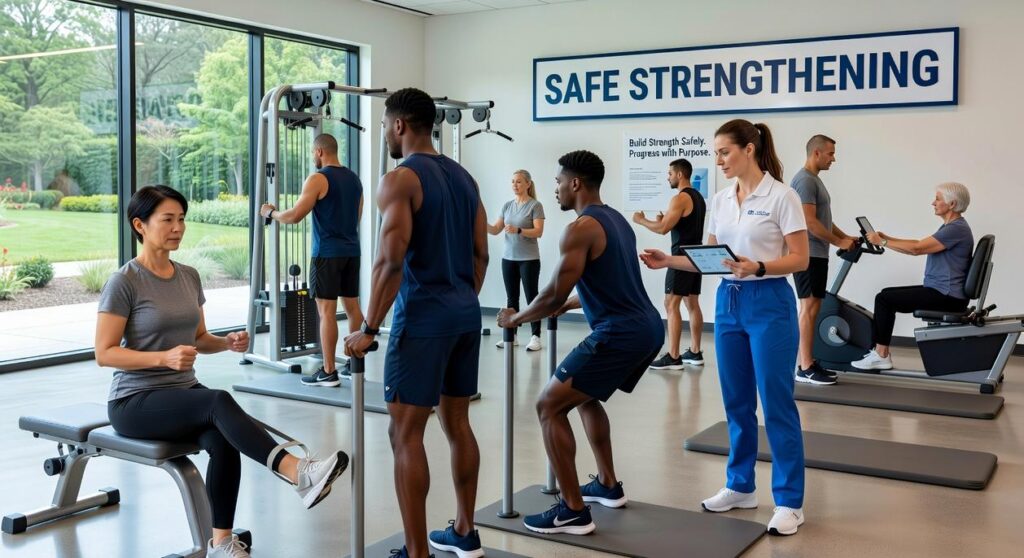
If you’ve ever finished rehab only to find the pain creeping back, you’re not alone. Many recovery plans ease symptoms but fall short of rebuilding the true, functional strength your body needs to stay injury-free. That’s where physical therapy strength integration changes the game. This guide explores how combining structured strength training with rehabilitative care helps you move beyond temporary relief and toward lasting resilience. Grounded in established sports medicine and evidence-based rehab principles, you’ll learn how targeted exercises are safely layered into PT programs to accelerate healing, prevent re-injury, and restore confident, capable movement.
From Rehabilitation to Resilience: The Science of Combining PT and Strength
Physical therapy (PT) focuses on restoring pain-free function and correcting imbalances—meaning uneven strength, mobility, or movement patterns that stress joints over time. In contrast, strength training builds tissue capacity (how much load muscles, tendons, and ligaments can handle) and increases force production. In simple terms, PT helps you move correctly again; strength helps you move powerfully.
Where the Real Transformation Happens
Think of PT as repairing a cracked foundation. A therapist assesses your “kinetic chain” (how joints and muscles work together) to find weak links—maybe limited ankle mobility after a sprain or underactive glutes contributing to knee pain. Research shows targeted rehab reduces reinjury risk (Journal of Orthopaedic & Sports Physical Therapy, 2017). However, stopping there leaves the structure vulnerable.
That’s where strength training comes in. Once pain subsides, progressively load those repaired areas. For example, transition from bodyweight split squats to weighted variations over weeks. Gradual overload strengthens connective tissue (NSCA Essentials of Strength Training).
Pro tip: If an exercise causes sharp pain, regress it—not quit entirely.
In practice, physical therapy strength integration means first identifying weak links, then systematically reinforcing them. Over time, you’re not just “fixed”—you’re resilient (think Batman after training, not before).
Smart & Safe Strengthening: Core Principles for Your Recovery Journey
Recovery isn’t about “going hard.” In my opinion, it’s about going smart. Too many people treat rehab like a bootcamp montage from a superhero movie (minus the background music and instant results). Real strength, especially after injury, is built with precision.
Principle 1: Progressive Overload in a Clinical Setting
Progressive overload means gradually increasing the demand placed on your body so it adapts and gets stronger. In rehab, that doesn’t automatically mean heavier weights. A therapist might adjust:
- Repetitions or sets
- Tempo (how fast or slow you move)
- Range of motion
- Stability challenges
Research shows gradual load progression supports tissue adaptation and reduces reinjury risk (American College of Sports Medicine, 2022). In clinical practice, subtle changes often matter more than big jumps.
Principle 2: The Specificity of Exercise Selection
Specificity means training the exact muscle or movement pattern that needs support. For example, strengthening the gluteus medius—a hip stabilizer—can improve knee alignment and reduce knee pain (Journal of Orthopaedic & Sports Physical Therapy, 2018). I firmly believe random exercises waste recovery time; targeted work builds meaningful stability.
Principle 3: Form Is Non-Negotiable
Technique isn’t optional. In rehab, poor mechanics are corrected, not reinforced. This is where physical therapy strength integration becomes essential—blending strength work with precise movement retraining.
Principle 4: Understanding Pain vs. Discomfort
Finally, learn the difference between muscle fatigue (“the work”) and sharp or stabbing pain (“the warning signal”). Mild soreness is expected. Joint pain or instability is not. In my view, respecting that line is what separates steady progress from frustrating setbacks.
Putting It Into Practice: Strength Exercises for Common PT Programs
Strength work in rehab isn’t just about “getting stronger.” It’s about restoring joint mechanics, reducing pain triggers, and building resilience so daily life feels easier (and less like a negotiation with your body).
For Low Back Pain
Here, the priority is core stability (your ability to resist unwanted spinal movement) and glute activation (getting your hips to do their share of the work). Start with Bird-Dogs and Glute Bridges to groove neutral spine control. Once those feel steady, progress to Goblet Squats and light Romanian Deadlifts.
The benefit? Better load distribution through the hips instead of the lumbar spine. Research shows that targeted strengthening can significantly reduce chronic low back pain intensity and disability (JOSPT, 2021). In other words, you’re training your body to handle groceries, workouts, and long workdays with less flare-up risk.
For Knee Pain (Patellofemoral Syndrome)
This condition often stems from poor tracking of the kneecap. Strengthening the quads, glutes, and hamstrings improves alignment. Begin with Terminal Knee Extensions and Banded Lateral Walks. Then advance to controlled Step-Downs and Split Squats.
As strength improves, so does shock absorption and joint stability. Studies in BJSM highlight hip and quad strengthening as key drivers of pain reduction. The payoff? Climbing stairs without wincing (a small win that feels huge).
For Shoulder Impingement
The goal is scapular control—how well your shoulder blade moves—and rotator cuff strength. Start with Banded External Rotations and Face Pulls. Progress to Scapular Wall Slides, then a carefully executed Dumbbell Overhead Press.
This gradual physical therapy strength integration restores overhead capacity while minimizing irritation. Stronger shoulders also reduce tension that can compound stress—making approaches like stress management frameworks that support total health even more effective. Strong joints, calmer system, better performance. That’s a win-win.
From Discharge to Independence
Graduating from therapy isn’t the end; it’s the handoff. The true goal of PT is independence, not endless appointments. Think Clinic vs. Real World: in one, sessions are guided and corrective; in the other, you choose loads, pace, and recovery.
So what does a strong transition look like? Clear exercise parameters (sets, reps, tempo), progression rules, and red flags like sharp pain or swelling. This physical therapy strength integration plan bridges gaps.
At home or in a gym, start light, track progress, and reassess monthly. Structure beats guesswork—confidence follows consistency. Progress, then push intensity gradually forward.
Build a Stronger, More Resilient Body for Life
You came here to understand how to achieve real recovery—and now you know it doesn’t end when the pain fades. It begins with building lasting strength. Too many people stop at temporary relief, only to find themselves trapped in the frustrating cycle of re-injury. That’s where true change happens. By committing to physical therapy strength integration, you create a body that’s not just healed, but durable and resilient. Don’t settle for short-term fixes. Talk to your physical therapist today about a progressive strength plan and take the next step toward a stronger, injury-resistant future.
 Lajuana Riccardina is a thoughtful voice behind modern wellness and intentional living, bringing a warm and grounded perspective to health, balance, and everyday self-care. She is passionate about helping readers embrace realistic habits, stronger routines, and a more mindful lifestyle through practical guidance that feels both encouraging and achievable.